
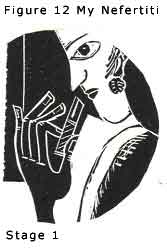
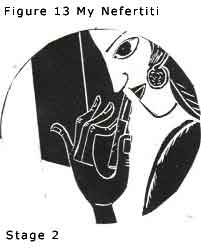
In the first stage of My Nefertiti, certain spatial relationships in the composition need to be addressed. So I decided to start a new stage in order to achieve what I want. In the final stage the straight at the base of the fingers is produced to form the straight denoting the arm-pit area. Finally, the straight forming the lower edge of the arm is produced to form the base for the shiny part of the hair. The curves appearing in the composition in the breast and elsewhere have the curvatures of perfect circles or coils.
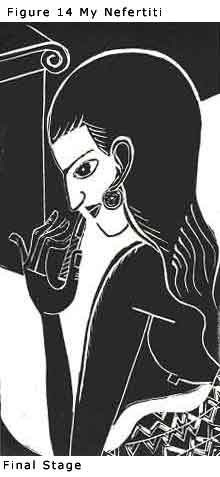
Unfortunately, the second stage of My Nefertiti is not a good resolution either. It does not show the specific facial features that I want what is essentially an imagined Egyptian beauty to assume. Finally, the third and final stage yields a portrait that even the great Titian would smile at.
In this composition may be found a complex system of supreme spatial relationships, each facet or fragment of which is designed to give rise to great visual pleasure.
Visual pleasure arises out of the actualization of the supreme mathematical relationship from which we derive the notion of the sublime.
When Einstein looked at certain mathematical relationships found in the universe, he exclaimed that he had seen the hand of the Creator in it. Likewise, Schrödinger, under a similar circumstance, proclaimed that we (the transient beings) are actually God Almighty Himself. Those mystics of scientists were able to see what Buddha saw at his moment of enlightenment under a tree. This seeing makes each of them the Buddha.
The goal of a viewer is to examine the work's vitality, movement, integrity in their calligraphic and poetic elements. To detect those dynamics in a masterfully executed painting, we must look at art intently. We must look at it and look at it until it speaks to us in our native tongues, calling us each tenderly by our names. Seeing beauty until we "swoon into our own dying" (quoting Ken Wilber). Formal transfiguration in great art is what imparts life to the work. That is what makes the art so timelessly engaging. That transfiguration which also transforms the viewer.

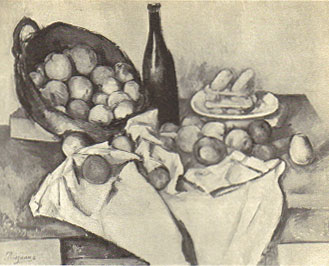
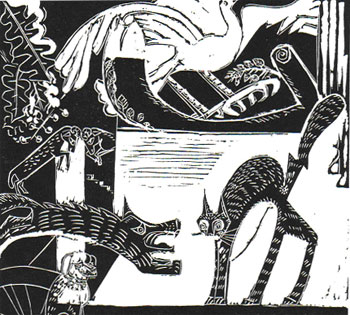
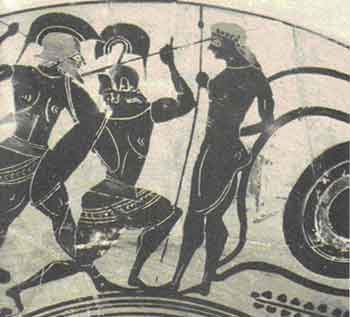
In the above composition, the compactness of forms is not just evident in the individual animal configuration but also throughout the entire structure of the composition. The ring formed of the bodies of the three animals is as solidly grounded as that formed in the "ring" of the dancers in Matisse's Dance. An elaborate geometric groundwork has made this compactness possible.
Until one has learnt how to look, the vicious cycle of getting fooled would never, ever be broken.
Ben Lau · Spring 2005